
What's New in the Canon EOS R6 Mark III
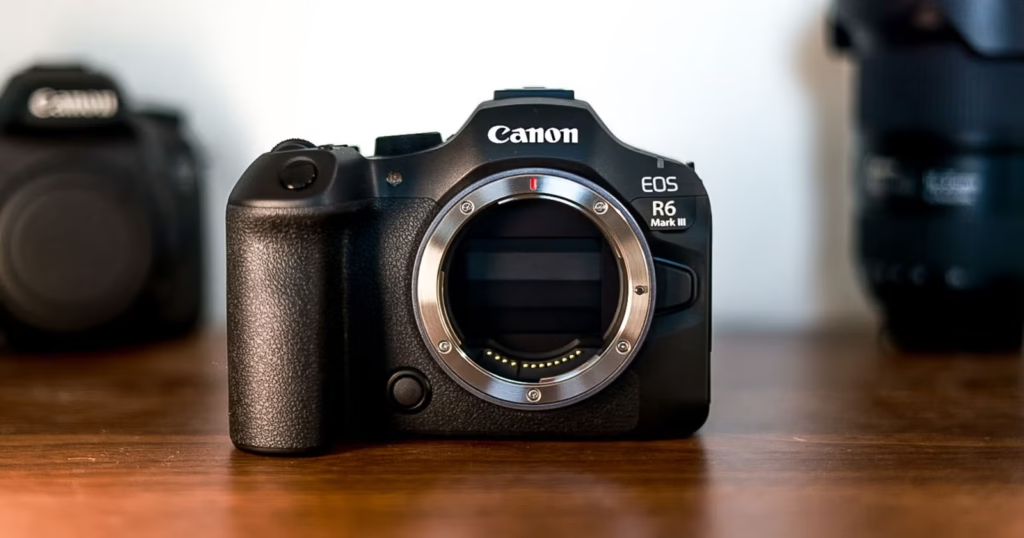
Canon’s R6 line has always been the camera people recommend to friends who want something better than an entry-level body without spending R5 money. The EOS R6 Mark III keeps that tradition alive, but it doesn’t feel like a minor refresh. After three years with the Mark II as the reigning favorite, Canon finally gave this series a real overhaul, and the results are hard to ignore whether you shoot weddings, wildlife, or YouTube videos in your garage.
This review breaks down what’s actually new, who it’s built for, and whether it deserves a spot in your bag at its $2,799 price point.
The headline change is the sensor. Canon swapped the Mark II’s 24.2-megapixel chip for a 32.5-megapixel full-frame sensor that’s new for Canon’s hybrid mirrorless lineup, having only recently appeared in the cinema-focused EOS C50. That’s roughly a 34 percent jump in resolution, which translates into more room to crop, bigger prints, and noticeably more detail in landscape and portrait work. Digital Photography Review
Autofocus and Burst Shooting
Canon carried over its excellent Dual Pixel CMOS AF II system and pushed it further with deep-learning subject tracking that recognizes people, animals, trains, and planes. The camera also includes a dedicated Photo/Video Mode Switch that adjusts the menus and settings depending on which mode you’ve chosen, which sounds small but makes a real difference when you’re switching between stills and video mid-shoot. Camera Decision
Speed is where this camera really shows off. It can fire off bursts at up to 40 frames per second using the electronic shutter, with a mechanical option for situations where rolling shutter distortion matters. Pre-capture buffering means the camera can grab frames from just before you fully press the shutter button, which is a lifesaver for unpredictable wildlife or sports moments.
Video Capabilities
This is arguably where the Mark III pulls furthest ahead of its predecessor. It records 7K open-gate RAW video internally, along with 4K up to 120 frames per second for slow motion and Canon Log 2 for color grading flexibility. Those numbers used to belong to dedicated cinema cameras, not a hybrid body in this price range.
Image Stabilization and Build
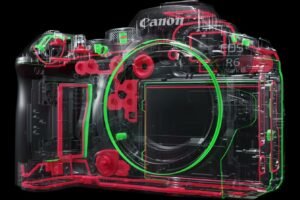
In-body stabilization rated up to 8.5 stops makes handheld shooting in low light far more forgiving, and several reviewers have noted it nearly removes the need for a gimbal in casual video work. The body itself feels more substantial than the Mark II, with a deeper, more texturized grip that holds up well even in harsh weather.
Pros and Cons
What works well:
The ergonomics are excellent, with a control layout that feels natural after just a few minutes of use. Low-light autofocus performance is confident and locks on quickly even in near darkness. The 40fps burst mode delivers a high keeper rate, which matters more than the headline number itself. And the video specs genuinely compete with cameras costing twice as much.
Where it falls short:
Switching between mechanical and electronic shutter modes still requires a manual toggle, which feels like an oversight Canon should fix with a firmware update. Battery life hasn’t really improved over the previous generation despite the higher price tag. The 7K video files are massive, which means budgeting for expensive CFexpress Type B cards and more storage than you’re probably used to. And if you’ve got larger hands, the grip could stand to be a touch deeper.
Real-World Use Cases
Photographers who’ve taken this camera into the field describe it holding up impressively under pressure. One reviewer used it for a wildlife expedition to Antarctica, tracking gentoo penguins porpoising through icy water, and reported clean, sharp bursts with the focus locked precisely on the subject’s eye from the very first frame. Another tested it during a New York snowstorm with temperatures hovering around 10 to 13 degrees Fahrenheit for over two hours straight, and the camera kept performing without overheating or letting in moisture.
For everyday use, the Mark III is just as comfortable photographing family portraits and fast-moving kids as it is shooting wildlife with a long telephoto lens. Content creators who need both strong stills and serious video specs in one body will find this camera particularly well suited to hybrid work, whether that’s client photography by day and B-roll capture by evening.
How It Compares
Against its own predecessor, the EOS R6 Mark II, the Mark III brings a meaningful resolution bump, faster sensor readout, and far more advanced video features, though the Mark II remains a strong, more affordable option now sitting around $2,299.
Compared to Nikon’s Z6III, the R6 Mark III holds its own in image quality, and Canon’s design doesn’t suffer from the higher read noise in shadow areas that affects Nikon’s partially stacked sensor.
Against Sony’s a7 V, the Sony edges ahead slightly in dynamic range but lacks some of the video features the R6 Mark III offers natively, like open-gate recording and internal RAW capture. One caveat across all three brands: each restricts third-party lens compatibility to some degree, so it’s worth checking lens availability for your specific needs before committing to a system.
If video is your main priority rather than stills, Canon has also released the EOS R6 V, a video-first variant with the same sensor but no viewfinder, active cooling, and ergonomics built specifically around content creators.
Frequently Asked Questions
Is the Canon EOS R6 Mark III good for beginners?
It’s more capable than most beginners need right away, but the menu system and controls are intuitive enough that a motivated newcomer won’t feel overwhelmed. It’s better suited to someone ready to grow into a serious hybrid camera.
Does it overheat during long video recording?
Some reviewers have noted overheating can become a limitation during extended high-resolution video sessions, particularly in warm conditions. For shorter clips and typical content creation, this isn’t usually an issue.
Is the upgrade from the R6 Mark II worth it?
If you specifically want the extra resolution, pre-capture shooting, or the significantly upgraded video specs, yes. If your current Mark II is meeting your needs, most photographers can comfortably wait for the next generation.
What memory cards does it need?
The camera supports CFexpress Type B cards, which are necessary to keep up with the higher-resolution video files, especially at 7K.
Is it weather-sealed?
Yes, the body is weather-resistant and has proven capable in snow, sleet, and cold temperatures during real-world testing, though pairing it with non-weather-sealed lenses can undermine that protection.
Final Verdict
The Canon EOS R6 Mark III earns its place as one of the most well-rounded mid-range mirrorless cameras available right now. It doesn’t reinvent what the R6 series stands for, but it sharpens nearly every part of the experience, from resolution and autofocus to video capability that punches well above its price class. The higher cost and the need for pricier memory cards are real considerations, but for photographers and hybrid shooters who want a camera that handles almost anything thrown at it, this is an easy recommendation.